In order to study for Friday's map quiz, visit the following site:
http://www.ilike2learn.com/ilike2learn/africa.html
Wednesday, January 5, 2011

Wednesday, 1/5/2011 Homework: Resources in Africa

Examine the maps on p. 419 and p. 405. Use them to answer the following questions:
1.List FIVE countries that produce petroleum.
2.List THREE countries where commercial farming is a major economic activity.
3.List THREE countries in southern Africa that produce diamonds.
4.Identify TWO countries where livestock is an important commodity.
5.List the countries that include manufacturing and trade centers.
6.Fish is an important food in a number of African countries. Identify FIVE countries where fish is an important food resource.
7.List FIVE countries where you might find gold, platinum or other precious metals.
8.List FIVE countries which appear to exist mostly at the FOLK level of society (based on the information given on the map).
Monday, January 3, 2011
A Brief African Odyssey

This activity is a series of maps of Africa studded with thumbnail pictures. If you click on a picture, a larger version of it will pop up. The pictures express a particular theme for that page, including: geography, culture, religion, making a living, transportation, and where people live.
You will complete this assignment in an e-mail to me. It is due at the end of today's class period. The assignment is worth a total of 20 points, with points deducted for grammar, completeness and accuracy of responses.
Map 1: Physical Geography
Click on the following link:
http://exploringafrica.matrix.msu.edu/students/curriculum/m3/activity1.php
Then, do the following for each picture:
- Briefly describe the photo.
- Name the landforms present in the photo.
- Describe the climate shown in the photo.
- Describe the vegetation visible in the photo.
Map 2: Culture
Click on the following link:
http://exploringafrica.matrix.msu.edu/students/curriculum/m3/activity2.php
Then, answer the following:
- What types of music, art and culture do you see in the photos?
- Does anything remind you of something similar you've seen in the U.S.? Explain.
Click on the following link:
http://exploringafrica.matrix.msu.edu/students/curriculum/m3/activity3.php
Then, answer the following, including references to specific photo numbers when appropriate:
- What are the different types of religious buildings you see in these pictures? Do you recognize any of them?
- Can you definitively associate any religion with any of the buildings?
- Do any of them look like anything you are familiar with in Chicago? Explain.
Click on the following link:
http://exploringafrica.matrix.msu.edu/students/curriculum/m3/activity4.php
Then, answer the following:
- What jobs are shown in the photos?
- What can the location of these jobs tell you about the area? (HINT: think about climate, vegetation, landforms and natural resources)
- Could you find employment in any of the industries shown in Chicago? If not, give an example of a place in the United States where a person might be able to find the type of job(s) shown.
Click on the following link:
http://exploringafrica.matrix.msu.edu/students/curriculum/m3/activity5.php
Then, do the following for each photo:
- Describe the photo. Include the region in Africa in which the photo is located (using compass directions) and specific information about the environment shown.
- Describe the type of transportation shown. Explain what this might tell you about the people living in the region.
For tonight, read Chapter 18, Section 1 in your textbook (pp. 414-418). Take Cornell Notes on the section in your notebooks. If you need a refresher on the Cornell Note taking system, take a look at this link from Cornell University.
The notes are worth 10 points, and are due on your desk at the start of tomorrow's class period.
Friday, December 10, 2010
Friday, 12/10/2010 Homework: Exam Review Questions
 Complete the following questions for homework on the same sheet of paper that you completed the previous questions. The assignment must be on your desk at the start of Monday's class period.
14. What is the cultural legacy of the Roman Empire?
15. How did the Roman Empire spread Christianity? Why are so many Americans Christian?
16. What was the Black Death? Where did it originate? How did it come to Europe? How was it transmitted? Imagine the modern world. What would be the fastest way for something like the Black Death to travel?
17. Who was Charlemagne? Why is he important?
18. What is nationalism? How did this concept alter Europe's political makeup?
19. Name and describe each of the three levels of society. Then, give an example of each from the topics studied in Quarter 2.
20. What is a nation-state? How did nation-states affect Europe?
21. Who was Adolf Hitler? Why was he important?22. Compare and contrast the British and Roman Empires.
Thursday, December 9, 2010
Thursday, 12/9/2010 Homework: Exam Review Questions
 Complete the following questions on loose leaf paper for homework. The assignment is due on your desk at the start of tomorrow's class. You may use your textbook and notes to find the answers.
- Name the peninsulas containing the following countries:
- Italy
- Spain
- Sweden
- Describe the relative location of: the Pyrenees, the Alps, and the Apennines.
- Explain why southern Europe is dominated by mountain chains while northern Europe is mostly plains.
- Assess the ways in which Europe’s physical geography aided its development as a center for world trade.
- Define “mistral” and “sirocco” winds.
- Describe the impact of the North Atlantic Drift on weather patterns in Northern Europe.
- Which two major rivers served as Europe’s highways?
- Define polis. Then, explain how this form of political unit defined Greek life.
- Define democracy. Which Greek polis is famous for practicing democracy?
- Where is Greece located? How did the physical geography of this location affect the lives of its people?
- Compare and contrast ancient Athens and Sparta.
- Describe the borders of the Roman Empire.
- What brought about the end of the Roman Empire?
Thursday, 12/9/2010: Exam Review Topics
 Topics for Quarter 2 Exam
50 pts. multiple choice, 100 pts. written
Review the following information in preparation for your Quarter 2 exam covering Europe and Russia. I will post review questions after this post.- Ch. 12-17
- Europe + Russia
- Map of Europe – countries and physical features
- Landforms of Europe and Russia
- Climate of Europe and Russia + causes
- Greece (Athens + Sparta + polis)
- Rome, how it became powerful, and how it ended
- Levels of society – folk, feudal, modern
- Spread of Christianity, spread of bubonic plague
- Trade routes
- Charlemagne, Napoleon + Hitler
- Causes of conflict in Eastern Europe (specifically, re: Russia and WWI)
- Why Russia became powerful, expanded
- Importance of Siberia + St. Petersburg
- Effects of Communism (Marx), Democracy
- Command Economy vs. Free Market Economy
- Difference between a political and economic system
Wednesday, December 1, 2010
Communism in Chicago
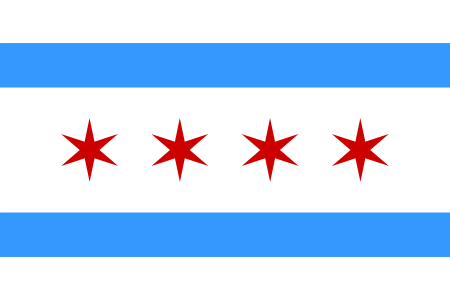
The Chicago government favors the rich and takes advantage of the poor. You, a poor worker, are upset, and turn to communism to solve your problems.
On a sheet of loose leaf paper, describe the steps you will take to create the perfect, MARXIST, communist society in Chicago. You should include at least 6 steps. Be creative! Make it a story. You will share this with the class.
The assignment is worth a total of ten points. Turn it in to the bin at the start of tomorrow's class.
HINT: Use your notes on Karl Marx. You may not actually like or agree with what you have to do to follow his guidance.
Subscribe to:
Posts (Atom)